Τετάρτη 21 Σεπτεμβρίου 2016

Home Harcover February 24, 2015 by Carson Ellis


“Home,” Maya Angelou wrote in her magnificent meditation on belonging and (not) growing up, “is that youthful region where a child is the only real living inhabitant.” Indeed, it seems that only for children, with their purity of feeling and their ability to “mediate the ideal and the real,” does the Venn diagram of home and house integrate into one fully overlapping circle. In adulthood, the circles drift further and further apart as we begin to project our conflicted dream-home ideals onto our real houses.
In the impossibly wonderful Home (public library), illustrator and children’s book author Carson Ellis presents an imaginative taxonomy of houses and a celebration of the wildly different kinds of people who call them home.


What emerges is a playful and tender reminder that however different our walks of life — what contrast there is between the Slovakian duchess’s mansion and the Kenyan blacksmith’s shack, between the babushka’s kitchen and the artist’s studio! — we are united by our deep desire for a place to call home.


After all, we begin belonging to his world — to borrow Mary Oliver’s wonderful phrase — first by rooting ourselves into it; by staking out a little corner of it to call our very own. It need not have walls or a roof — it can be a tour bus, or even a shoe, as Ellis’s illustrated taxonomy assures — but only from that place of safety can we reach out to connect, to understand one another, and to begin belonging together.


Ellis guides the reader to and through this common thread of belonging by placing little semi-hidden markers of communion and continuity — the same house plant graces multiple homes; a pigeon visits the young girl in Brooklyn and then perches on the Russian babushka’s window; the icon that hangs on the wall of the babushka’s kitchen is seen, several pages later, on the wall of the artist’s studio. (The artist, endearingly enough, is Ellis herself.)


Sprinkled amid the very real homes of very real people from different cultures are the whimsical abodes familiar from beloved tales — right next to the Japanese businessman is the Norse god, proudly standing before his magical palace, and a giant upside-down cup calls to mind Leonard Weisgard’s magnificent mid-century illustrations for Alice in Wonderland.


Home is the kind of book that legendary editor Ursula Nordstrom, perhaps the greatest patron saint of childhood who ever lived, might say “can’t help but make any child warmed and attended to and considered.” Complement it with the best children’s books of the past year

Δευτέρα 19 Σεπτεμβρίου 2016

Ansel Adams Great photographs of American Nationa Parks

Adams Yellowstone
Like many American stories, the story of the National Parks begins with pillage, death, deep cultural misunderstanding, and venture capitalism. According to Ken Burns’ film series The National Parks: America’s Best Idea, we can date the idea back to 1851, with the “discovery” of Yosemite by a marauding armed battalion who entered the land “searching for Indians, intent on driving the natives from their homelands and onto reservations.” The Mariposa Battalion, led by Captain James D. Savage, set fire to the Indians’ homes and storehouses after they had retreated to the mountains, “in order to starve them into submission.” One member of the battalion, a doctor named Lafayette Bunnell, found himself entranced by the scenery amidst this destruction. “As I looked, a peculiar exalted sensation seemed to fill my whole being,” he wrote in his later accounts, “and I found myself in tears with emotion.” He named the place “Yosemite,” thinking it was the name of the Indian tribe the soldiers sought to force out or eradicate. The word, it turned out “meant something entirely different,” referring to people who should be feared: “It means, ‘they are killers.’”
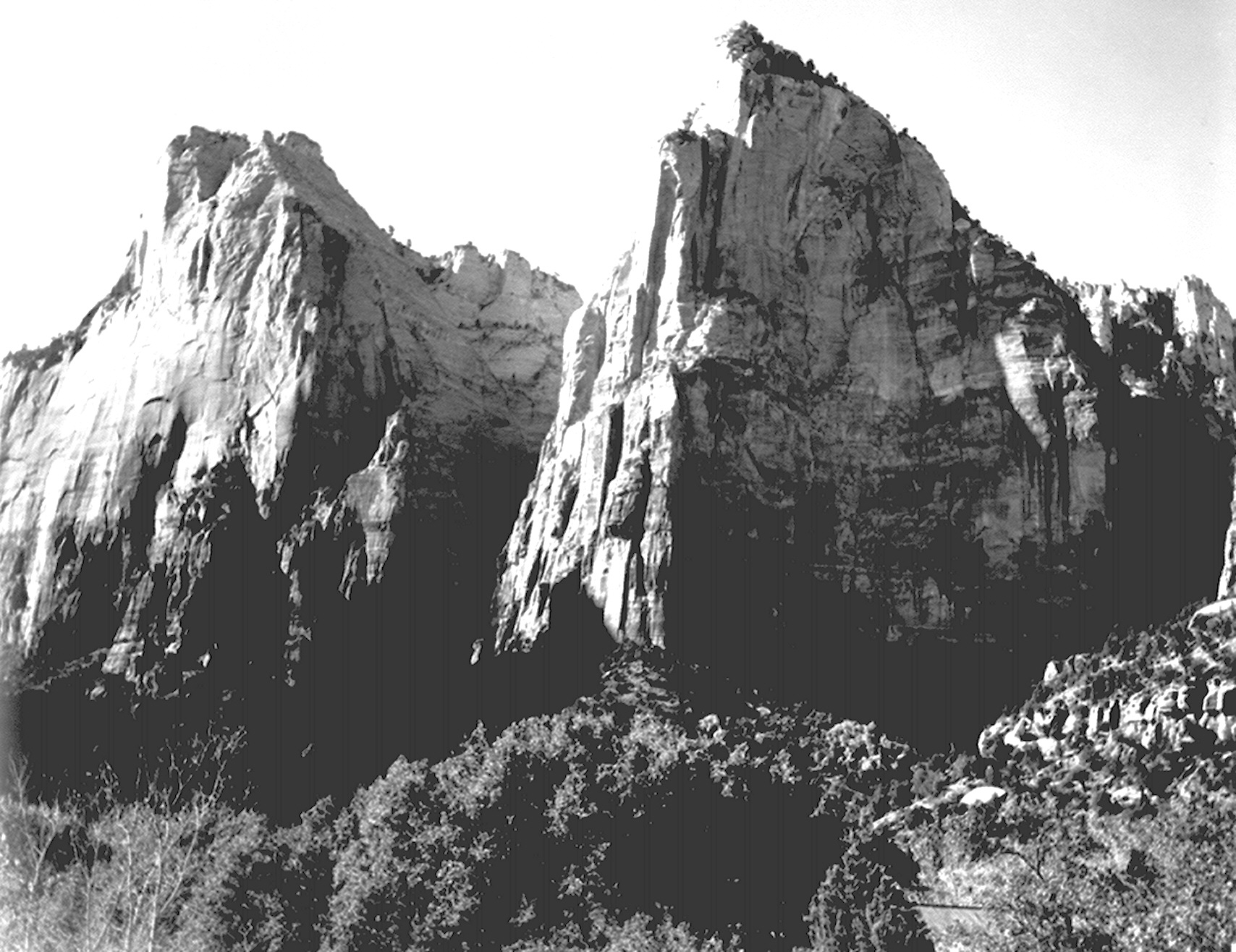
Zion Adams
In 1855, a failed English gold prospector turned the place into a tourist attraction, and people flooded West to see it, prompting New York worthies like Horace Greeley and Frederick Law Olmsted to lobby for its federal protection. In 1864, Abraham Lincoln deeded Yosemite Valley and the Mariposa Grove, with its giant sequoias, to the state of California. Ever since then, National Parks have been threatened—if not by the occasional political candidate and his billionaire backers hoping to privatize the land, then by oil and gas drilling, and by fire, rising seas, or other effects of climate change. Though the U.S. emptied many of the parks of their inhabitants, it is ironically only the actions of the federal government that prevents the process begun by the Mariposa Battalion from reaching its conclusion in the total despoliation of these landscapes. It is these landscapes that have most come to symbolize the national character, whether as background in Frederic Remington’s paintings of the Indian Wars or in the photographs of Ansel Adams, who began and sustained his career in Yosemite Valley. “Yosemite National Park,” writes the National Park Service’s website,” was Adams’ chief inspiration.”
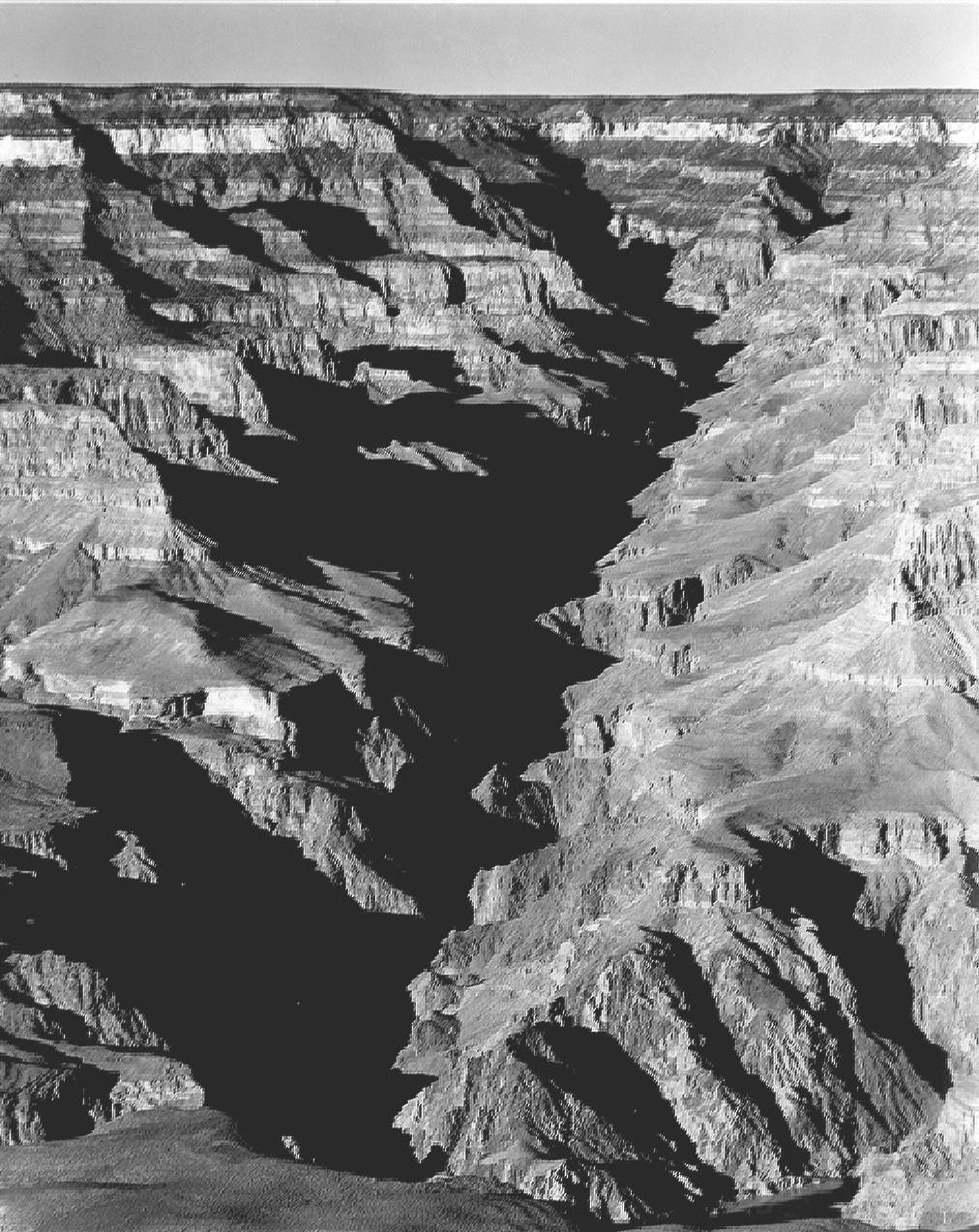
Grand Canyon Adams
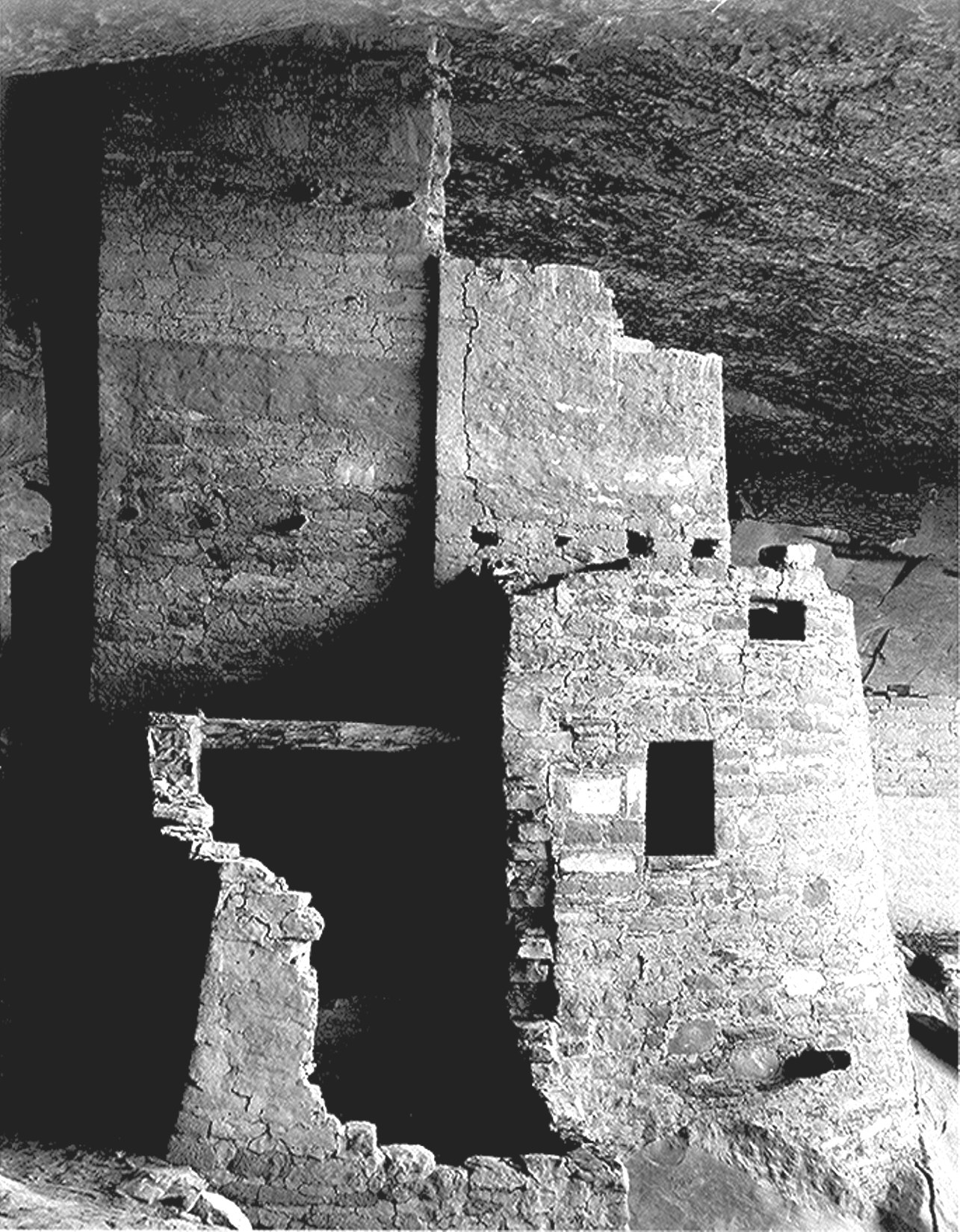
Adams first became interested in visiting the National Park when he read In the Heart of the Sierras by James Hutchings—that failed English gold prospector. Thereafter, Adams photographed National Parks almost ritually, and in 1941, the National Park Service commissioned Adams to create a photo mural for the Department of the Interior Building in DC. The theme, the National Archives tells us, was to be “nature as exemplified and protected in the U.S. National Parks. The project was halted because of World War II and never resumed.” It must have felt like an especially sacred duty for Adams, who traveled the country photographing the Grand Canyon, Grand Teton, Kings Canyon, Mesa Verde, Rocky Mountain, Yellowstone, Yosemite, Carlsbad Caverns, Glacier, and Zion National Parks; Death Valley, Saguro, and Canyon de Chelly National Monuments,” and other locations like the Boulder (now Hoover) Dam and desert vistas in New Mexico.
Mesa Verde Adams
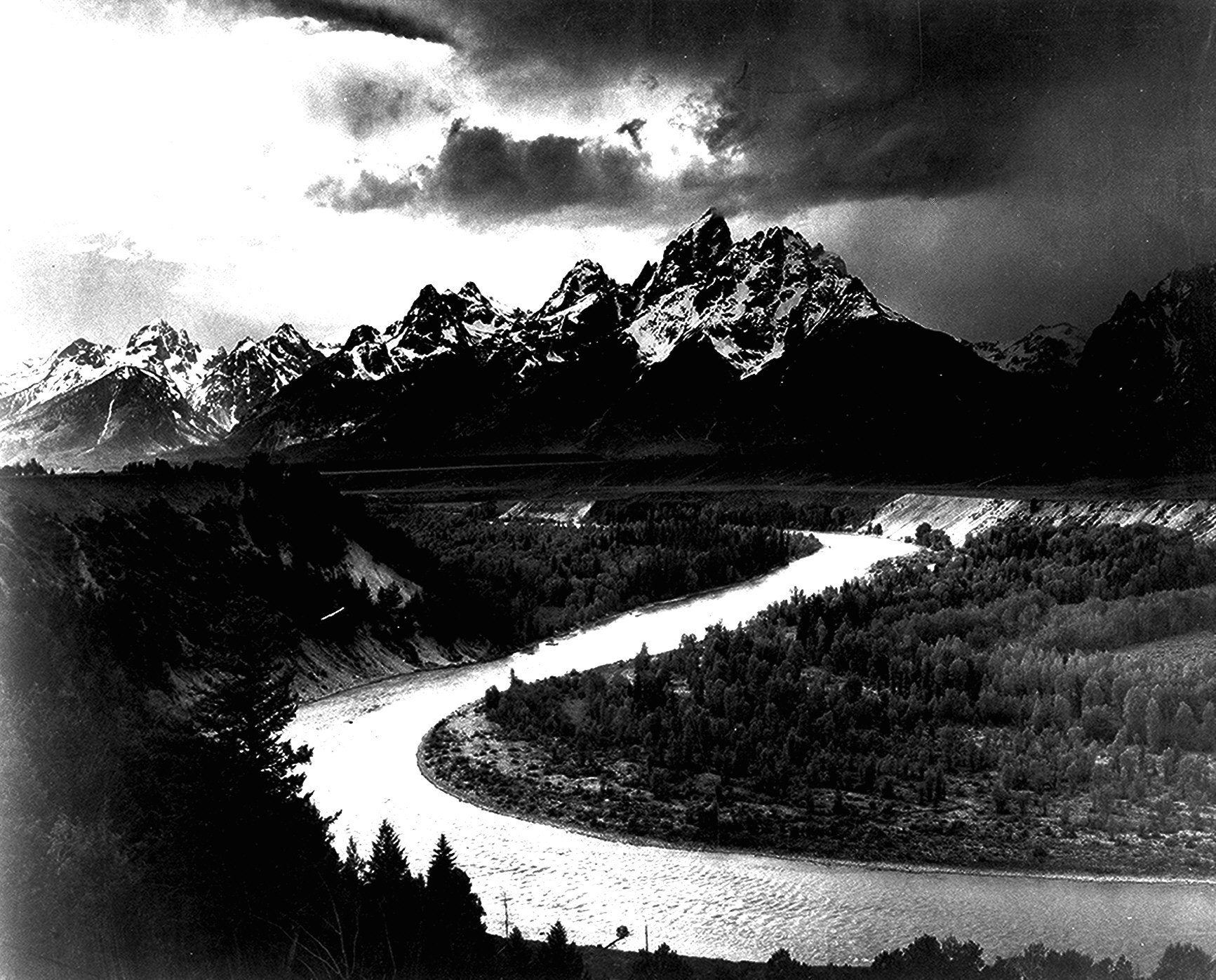
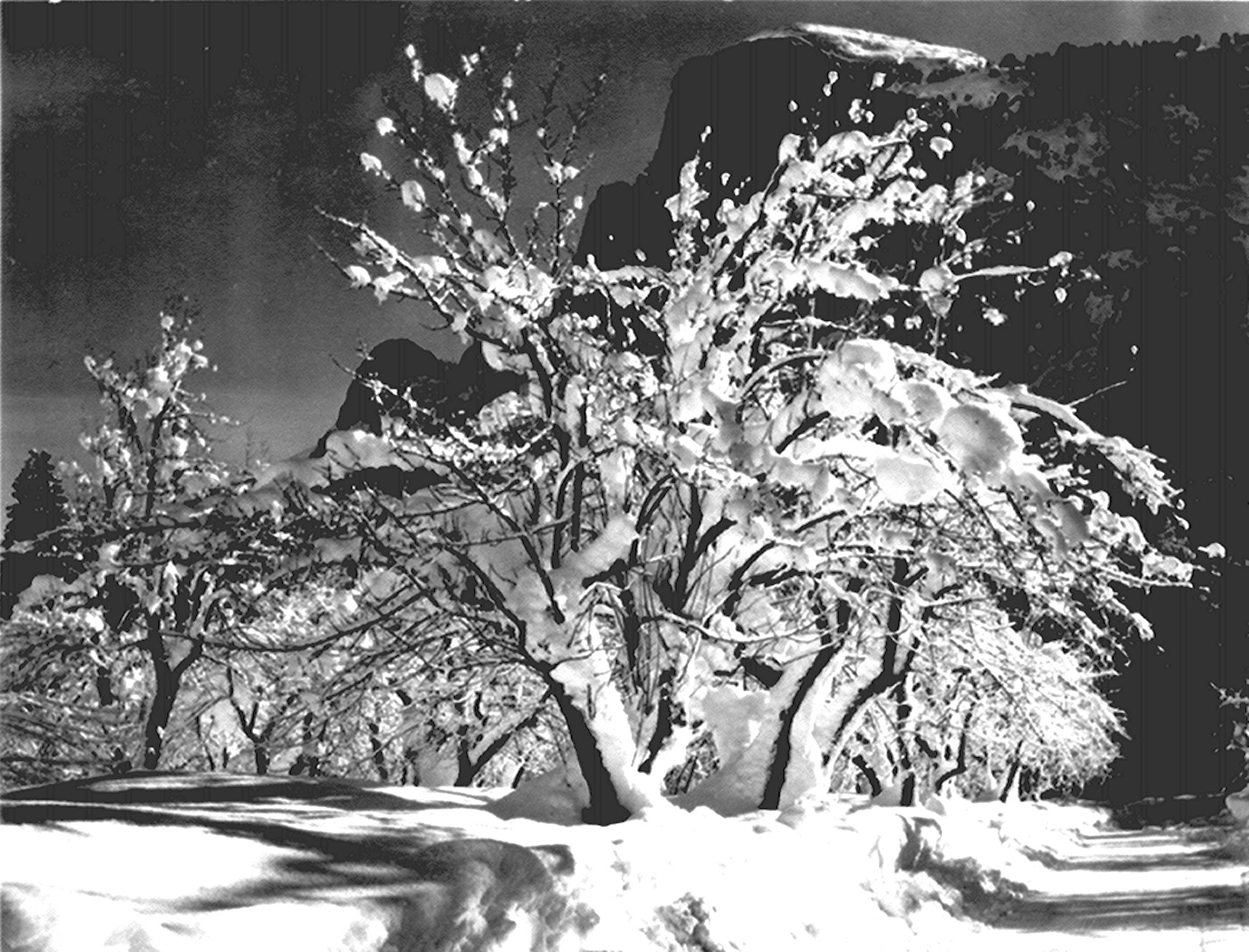
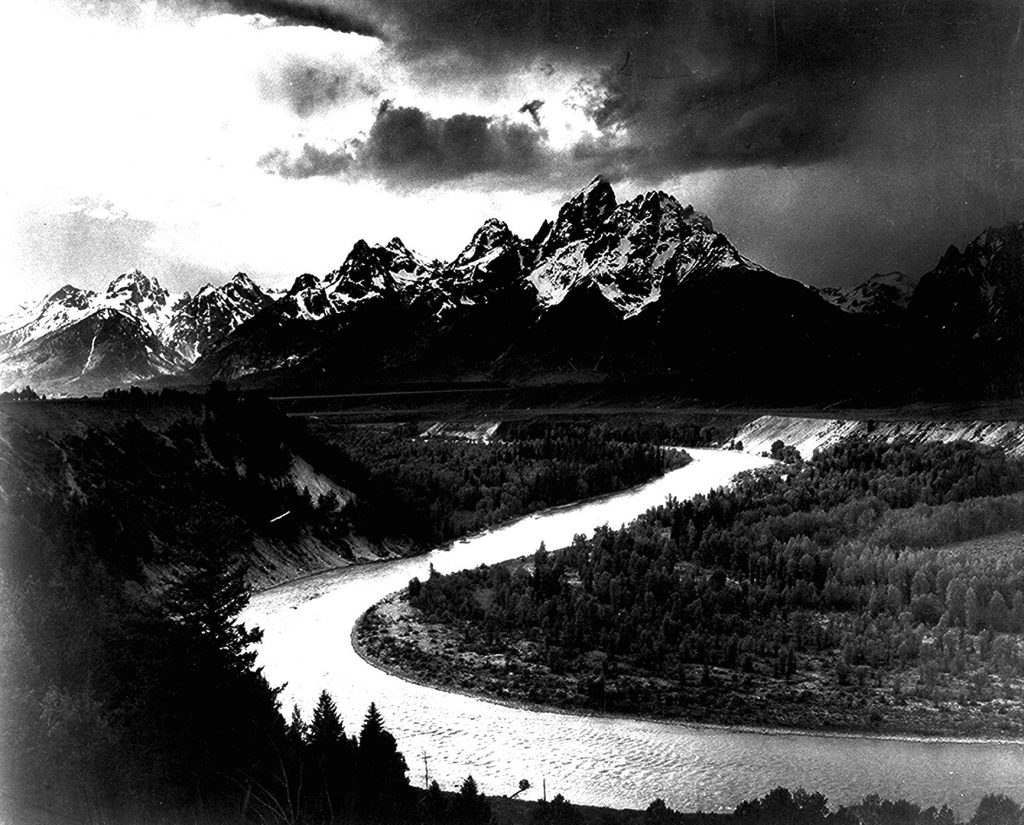
The photographs you see here are among the 226 taken by Adams for the project. They are now housed at the National Archives, and you can freely view them online or order prints at their site. At the top, we see a snow-covered tree from an apple orchard in Half Dome, Yosemite, where Adams had his first photographic “visualization” in 1927. Below it, the “Court of the Patriarchs” in Zion National Park, Utah. Further down, we have a breathtaking vision of the serpentine Grand Canyon, and just above, one of the few manmade structures, “Cliff Palace” at Mesa Verde National Park in Colorado. And here can you see a photograph of the Snake River in Grand Teton National Park.
adams grand teton
The mural project may have been abandoned, but Adams never stopped photographing the parks, nor advocating for their protection and, in fact, the protection of “the entire environment,” as he told a Playboy interviewer in 1983. “Only two and a half percent of the land in this country is protected,” said Adams then: “Not only are we being fought in trying to extend that two and a half percent to include other important or fragile areas but we are having to fight to protect that small two and a half percent. It is horrifying that we have to fight our own Government to save our environment.”

The planets A cosmic pastoral (poems) Hardcover 1976 by Diane Ackerman

On February 19, 1974, shortly before visiting Timothy Leary in prison, Carl Sagan sent the psychedelic pioneer a letter discussing evolution, the possibility of extraterrestrial life, and the details of the upcoming visit. The postscript read:
P.S. The enclosed poem, ‘The Other Night’ by Dianne Ackermann [sic] of Cornell, is something I think we both resonate to. It’s unfinished so it shouldn’t yet be quoted publically.
But the poem was eventually finished and, along with fourteen others, included in the 1976 poetry anthology The Planets: A Cosmic Pastoral (public library) by Diane Ackerman — a whimsical and wonderful ode to the universe, celebrating its phenomena and featuring a poem for each planet in the Solar System, as well as one specifically dedicated to Carl Sagan.
From “Venus”:
Low-keyed and perpetual,
a whirling sylph
whose white robe stripes
around her; taffeta
wimpled like a nun’s headcloth;
a buxom floozy with a pink boa;
mummy, whose black
sediment desiccates within; wasp-star
to Mayan Galileos;
an outpatient
wrapped in post-operative gauze;
Cleopatra in high August–
her flesh curling
in a heat mirage
lightyears
from Alexandria;
tacky white pulp
spigoted
through the belly of a larva;
the perfect courtesan:
obliging, thick-skinned,
and pleated with riddles,
Venus quietly mutates
in her ivory tower.
Deep within that
libidinous albedo
temperatures are hot enough
to boil lead,
pressures
90 times more unyielding
than Earth’s.
And though layered cloud-decks
and haze strata
seem to breathe
like a giant bellows,
heaving and sighing
every 4 days,
the Venerean cocoon
is no cheery chrysalis
brewing a damselfly
or coaxing life
into a reticent grub,
but a sniffling atmosphere
40 miles thick
of sulphuric, hydrochloric,
and hydrofluoric acids
all sweating
like a global terrarium,
cutthroat, tart, and self-absorbed.
No sphagnum moss
or polypody fern here,
where blistering vapors
and rosy bile
hint at the arson
with which the Universe began.
Hubble Space Telescope photograph taken within minutes of Mars’ closest approach to Earth in 60,000 years, on Aug. 27, 2003. Click images for more
From “Mars”:
The quickest route
from Candor to Chaos
follows Coprates
(the much-travelled
Shit River), through
da Vinci and Galileo
bypassing Bliss,
many moons from Tranquility.
But, Romantics, take heart:
you can breakfast
in Syria, lunch in Sinai,
track the Nile
to its source (Nilokeras)
before dinner, and there,
making ablutions to Osiris,
win a boon to Eden,
where all four rivers
of Paradise converge,
then spend the night
in Pandora, or with Ulysses,
Proteus, or even Noah,
in the Land of Gold (Chryse)
or by the Leek-green Sea.
From “The Other Night (Comet Kohoutek)”:
Last night, while
cabbage stuffed with
brown sugar, meat and
raisins was baking in the
oven, and my potted holly,
dying leafmeal from red-spider,
basked in its antidote malathion,
I stepped outside to watch Kohoutek
passing its dromedary core through the
eye of a galaxy. But only found a white
blur cat-napping under Venus: gauzy, dis-
solute, and bobtailed as a Manx.
Pent-up in that endless coliseum of stars,
the moon was fuller than any Protestant
had a right to be. And I said: Moon,
if you’ve got any pull up there, bring me
a sun-grazing comet, its long hair swept
back by the solar wind, in its mouth a dollop
of primordial sputum. A dozing iceberg,
in whose coma ur-elements collide. Bring me
a mojo that’s both relict and reliquary.
Give me a thrill from that petrified seed.
Mars was a stoplight in the north sky,
the only real meat on the night’s black
bones. And I said: Mars, why be parsimonious?
You’ve got a million tricks stashed
in your orbital backhills: chicory suns
bobbing in viridian lagoons; quasars dwindling
near the speed of light; pinwheel, dumbbell,
and impacted galaxies; epileptic nuclei
a mile long; vampiric moons; dicotyledon suns;
whorling dustbowls of umbilical snow; milky ways
that, on the slant, look like freshly fed pythons.
From “Diffraction (for Carl Sagan)”:
When Carl tells me it’s Rayleigh scattering
that makes blue light, canting off molecular
grit, go slowgait through the airy jell, subdued,
and outlying mountains look swarthy, or wheat
blaze tawny-rose in the 8:00 sun, how I envy
his light touch on Earth’s magnetic bridle.
Knee-deep in the cosmic overwhelm, I’m stricken
by the ricochet wonder of it all: the plain
everythingness of everything, in cahoots
with the everythingness of everything else.
Echoing Richard Feynman’s views on science and mystery, Ackerman writes of her poetry:
I’ve always been baffled by people who write about nature only in terms of, say, junipers and cornfields, eschewing all things so-called ‘scientific,’ as if science were, per se, the spoil-sport of feeling. So wonderless a view of nature really doesn’t appeal to me; I don’t see the Universe divided up that way, into ‘The Junipers’ on the one hand and ‘The Amino Acids’ on the other.

So how did Sagan know of Ackerman? Most likely, through his second wife — the author photograph on the back of The Planets: A Cosmic Pastoral was taken by artist and writer Linda Salzman Sagan, whom Carl married in 1968. The two divorced in 1981, after Sir Sagan fell in love with Annie Druyan in the course of creating the Voyager Golden Record, which Linda co-produced. Cosmic love, it seems, is always a little more complicated than the poets might wish us to believe.
Complement with the first poem published in a scientific journal, which actually turned out not to be the first.

Summer Birds The Butterflies of Maria Merian

While putting together the annual omnibus of the year’s best children’s books, I was reminded of how woefully rare inspired children’s books about science are in our culture — as rare, perhaps, as are homages to pioneering female scientists and celebrations of the intersection of art and science. The confluence of these three rarities is what makes Summer Birds: The Butterflies of Maria Merian (public library) so wonderful. Writer Margarita Engle and artist Julie Paschkis — the talent behind the gorgeous illustrated tale of Pablo Neruda’s life — tell the story of 17th-century German naturalist and illustrator Maria Merian (April 2, 1647–January 13, 1717), whose studies of butterfly metamorphosis are among the most important contributions to the field of entomology in the history of science and forever transformed natural history illustration.


There are many ennobling and empowering threads to the story of Merian’s life — how she began studying insects as a young girl, two centuries before the dawn of science education for women; how she trained tirelessly in art, then brought those skills to illuminating science, all while raising her daughters; how she traveled to South Africa with her young daughter in an era when women had practically no agency of mobility; how she continued to work even after a stroke left her paralyzed.

But perhaps most pause-giving of all is the reminder of just how much superstition early scientists had to overcome in the service of simple truth: In Merian’s time, people considered insects evil and found the “supernatural” process of metamorphosis particularly ominous, believing it was witchcraft that transformed the insect from one state to another.

By meticulous and attentive observation, Merian proved that the process was very much a natural one, and beautifully so. She was only thirteen. Her groundbreaking work was a prescient testament to Richard Feynman’s famous assertion that science only adds to the mystery and the awe of the natural world.

When people understand the life cycles of creatures that change forms, they will stop calling small animals evil. They will learn, as I have, by seeing a wingless caterpillar turn into a flying summer bird.
On her site, Paschkis shares her research process and offers a fascinating history of insect illustration.
For a grownup take on Merian’s legacy, complement Summer Birds with Taschen’s lavish volume Maria Sibylla Merian: Insects of Surinam.


 Hardcover – April 27, 2010

The Tea Party in the Woods Hardcover – August 1, 2015 by Akiko Miyakoshi (Author, Illustrator)

To be human is to sometimes slip, then wish for a way to undo our mishaps and magically fix our mistakes. Japanese children’s book author and artist Akiko Miyakoshi explores this profoundly human impulse with uncommon subtlety and tenderness in The Tea Party in the Woods (public library) — a quietly whimsical modernist fairy tale with the imaginative other-worldliness of Alice in Wonderland, but without Carroll’s flamboyant farcicality; with the red-capped woods-wandering heroine of Little Red Riding Hood, but without the Grimms’ goriness. At the story’s heart is a gentle taunt at the line between what is real and what is imagined — a line we cross daily in ways minute and monumental by virtue of continually constructing the thing we call reality.

We meet young Kikko, who awakens one morning to find that her father has left for Grandma’s house but has forgotten the pie he was supposed to bring. Eager to help, Kikko grabs the pie-box and runs after him through the winter wonderland, following his tracks through the woods.

At last, she spots ahead of her a silhouette in a hat and a long black coat. But as she breaks into a run to catch up, Kikko trips into the deep snow and falls, crushing the pie box.

Devastated, she picks up the box and runs after her father, following him to a strange big house she hadn’t noticed before.


Upon seeing him go inside, she sneaks up to the window and peeks in. And then reality slips into the surreal — the coated figure turns out to have been not her father but “a great big bear,” now taking off his hat to greet an elegant doe in a white gown.

As Kikko struggles to make sense of the strangeness unfolding before her, another reality-warping creature approaches her.


A lady-lamb in a pea coat, carrying a purse, asks in a kind voice whether Kikko is there for the tea party too, then gently takes the girl’s hand and leads her into the house. Inside, Kikko finds herself amid an astonishing world — a coterie of animals, seated around a giant table in anticipation of some mysterious festivity.

They welcome the bewildered and timorous Kikko, take her coat, serve her tea, and make her the occasion’s special guest.

And then, slice by slice, they assemble a new pie onto her plate, each made with different berries and nuts gathered from the woods.


The doe packs this combinatorial creation into a new box, carefully ties it with a red ribbon, and hands it to Kikko as the animal party escorts the girl back out into the woods and sends her off with a joyful parade toward Grandma’s house to deliver the magically recovered pie.

As she steps into Grandma’s house, Kikko looks over her shoulder — but all the animals have disappeared and her world has returned to its familiar winter quietude.


Complement The Tea Party in the Woods with another Japanese masterwork of exceptional tenderness: Komako Sakai’s extraordinary reimagining of The Velveteen Rabbit.
Illustrations courtesy of Akiko Miyakoshi / Kids Can Press

Hubble Space Telescope

http://www.spacetelescope.org/images/


New view of the Pillars of Creation — visible
Westerlund 2 — Hubble’s 25th anniversary image
The Bubble Nebula
Antennae Galaxies reloaded
Extreme star cluster bursts into life in new Hubble imageA rose made of galaxies
New stars shed light on the past
Stellar Nursery in the arms of NGC 1672
ACS Image of NGC 5866
The magnificent starburst galaxy Messier 82
Largest ever galaxy portrait - stunning HD image of Pinwheel Galaxy